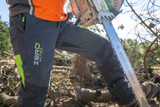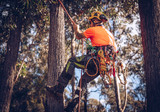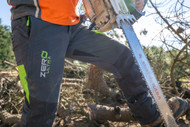
Do chainsaw chaps work with battery-powered chainsaws?
We can now say with certainty, yes. The latest version of the chainsaw leg protection standard, ASTM F1897-25, confirms that certified chainsaw PPE performs effectively against both battery-powered and gas-powered chainsaws. They slow and stop the chain through fibre jamming and resistance, regardless of whether the saw uses a clutch or an electric motor (Source: ASTM International).
Battery-powered chainsaws are now widely used across arboriculture, landscaping, utility work, and property maintenance. As performance improves, so does confusion around safety—especially whether traditional PPE still works.
This article breaks down what happens during a chainsaw contact event, why the hesitation around battery saws exists, and what the latest ASTM Standard confirms.
Why do people think chainsaw PPE doesn’t work with battery chainsaws?
The concern comes from two assumptions: that battery chainsaws lack a clutch system and that electric motors produce higher torque. These factors led some users to believe protective fibres cannot stop the chain, especially based on informal or uncontrolled tests (Source: industry safety discussions).
Most of these claims come from:
- Outdated assumptions about chainsaw mechanics
- Misinterpretation of how protective fibres function
- Poor-quality “backyard tests”
From what we’ve seen supplying both contractors and resellers, a lot of confusion comes from poorly set up DIY testing. A failure occurs, and the battery saw gets the blame, whereas the test method prohibited the protective fibers from working as they are intended.
How do chainsaw chaps stop a chainsaw?
Chainsaw protective clothing works by releasing high-strength fibres that clog and slow the chain mechanism upon contact. This creates resistance that rapidly reduces chain speed and ultimately stops the system, either through clutch disengagement (gas) or motor shutdown (battery).
When contact happens:
- Outer layer tears open
- Protective fibres are pulled into the chain
- Fibres wrap around drive components
- Chain speed drops rapidly
Two key effects:
- Braking effect: resistance slows the chain
- Jamming effect: fibres clog the drive system
This is consistent across certified garments and is the core mechanism validated in global standards.
What’s the difference between gas and battery chainsaw stopping mechanisms?
Gas and battery chainsaws stop differently, but the protective outcome is the same. Gas saws rely on clutch disengagement under resistance, while battery saws detect abnormal load and shut down electronically when fibres jam the system (Source: ASTM F1897-25 testing appendix).
Gas vs Battery — What Actually Happens
|
Feature |
Gas Chainsaw |
Battery Chainsaw |
|
Drive system |
Engine + clutch |
Direct motor drive |
|
Stopping trigger |
Clutch disengages |
Motor overload detection |
|
Fibre interaction |
Brakes saw chain and wraps sprocket |
Brakes saw chain and increases resistance load |
|
Outcome |
Chain stops |
Motor shuts down |
From a safety outcome perspective:
Both systems rely on fibre resistance to stop the chain.
What does the latest ASTM standard say about battery chainsaws?
The ASTM F1897-25 standard confirms that certified chainsaw protective garments perform similarly against battery-powered and gas-powered chainsaws under controlled laboratory testing. No performance failures were recorded across multiple manufacturers (Source: ASTM International, UL testing oversight).
To validate this:
- Standard test rigs were adapted with battery-powered saw heads
- Multiple PPE brands were tested
- Controlled lab conditions were used
- Testing was observed by UL (Underwriters Laboratories)
Result: No failures recorded
This removes a major uncertainty for:
- Arborists
- Contractors
- Safety managers
- Retail buyers evaluating PPE
(Source: ASTM F1897-25, Standard Specification for Leg Protection for Chainsaw Users)
Are all chainsaw chaps and trousers equally effective?
No. Performance depends on fibre engineering, garment construction, and certification, not just the number of layers. Certified PPE systems are designed to balance protection, weight, breathability, and fibre deployment speed under load.
More layers do not equal more protection.
What matters:
- Fibre strength and length
- Deployment speed
- Garment design integrity
- Certification standard (ASTM, EN, AS/NZS)
In our experience supplying both individual operators and reseller networks, the biggest performance difference comes from how the fibres behave under load—not how bulky the garment feels.
Poorly designed gear can:
- Be heavier
- Reduce mobility
- Increase heat stress
- Still underperform in real-world cuts
This is where engineered systems outperform generic PPE.
WATCH: Chainsaw Trousers vs. Chaps
Do you still need chainsaw PPE with a battery chainsaw?
Yes. Battery-powered chainsaws can cause severe injuries and should always be used with certified protective equipment. PPE remains a critical last line of defense, regardless of the power source or application environment.
Battery saws may feel:
- Quieter
- Easier to handle
- Less intimidating
But injury risk remains high due to:
- Chain speed
- Operator fatigue
- Kickback potential
For both:
- Professional crews
- Homeowners
PPE is non-negotiable.
Are battery chainsaws safer than gas chainsaws?
Battery chainsaws offer advantages such as lower noise, reduced emissions, and easier handling, but they are not inherently safer in terms of cutting injury risk. Chain speed and cutting capability remain sufficient to cause serious harm.
The safety difference is operational—not mechanical:
- Easier start
- Less vibration
- Reduced fatigue
But:
A moving chain is still a moving chain
What does this mean for arborists, contractors, and resellers?
Certified chainsaw PPE remains fully relevant for both battery and gas-powered tools, meaning businesses, crews, and retailers can confidently continue stocking and using ASTM-compliant protective gear without changing specifications or safety protocols.
This gives users:
- Confidence in protection
- Clear safety guidance
- Simplified buying decisions
Discover Clogger's range of chainsaw PPE
What should you look for when choosing chainsaw PPE?
Look for certified garments that meet recognized standards (ASTM, EN, or AS/NZS), are properly fitted, and are designed for your working conditions. Comfort, mobility, and breathability are critical for consistent real-world use.
Key considerations:
- Certification standard
- Fit and sizing
- Climate suitability (heat, fire risk, etc.)
- Application (climbing vs groundwork)
Discover your pair of Clogger Pants or Clogger Chaps.
Final takeaway: Does chainsaw PPE still work with battery chainsaws?
Yes. Certified chainsaw protective clothing works effectively with both battery-powered and gas-powered chainsaws, as confirmed by updated ASTM testing. The protective mechanism—fibre jamming and resistance—remains valid regardless of the saw’s power source.
Battery chainsaws are here to stay.
But the fundamentals haven’t changed:
- Wear certified PPE
- Use proper technique
- Maintain your gear
Or put simply:
Built for the grind.
Not just certified—better than the standard.
FAQ
Do chainsaw chaps stop battery chainsaws?
Yes. ASTM-certified chainsaw chaps have been tested and confirmed to perform effectively against battery-powered chainsaws by slowing and stopping the chain through fibre resistance and jamming (Source: ASTM F1897-25).
Is chainsaw PPE tested with battery saws?
Yes. The ASTM F1897-25 update includes testing with battery-powered chainsaws under controlled laboratory conditions with third-party oversight.
Do I need chainsaw chaps for a battery chainsaw?
Yes. Battery chainsaws can still cause severe injuries, and certified PPE remains essential for safe operation.